
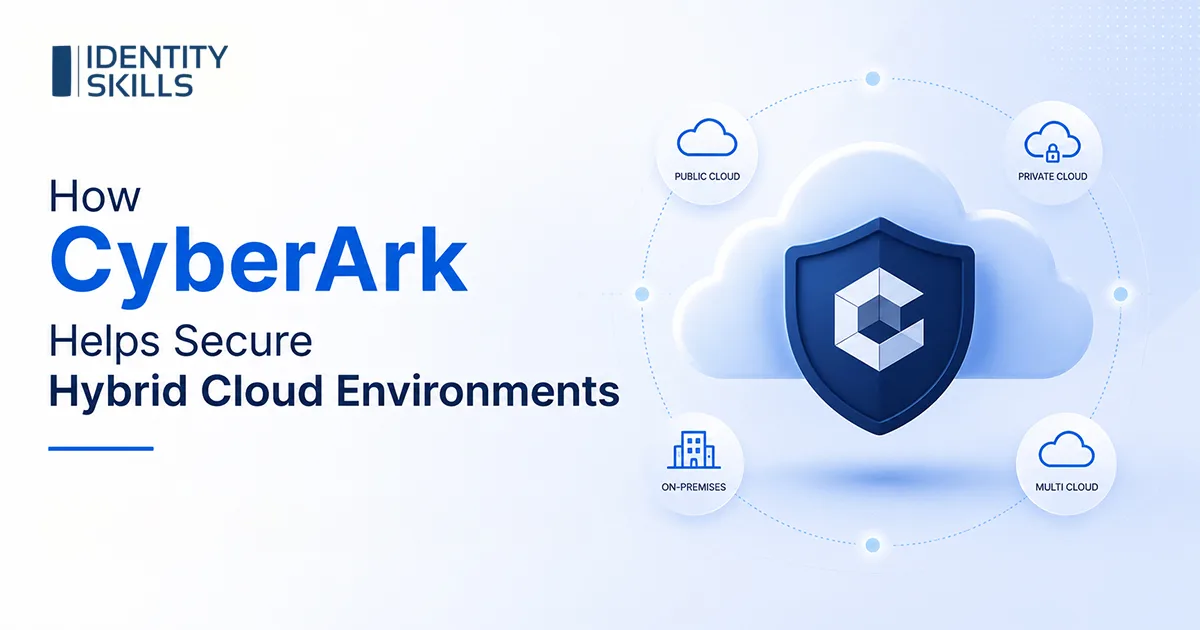
Today, most organizations are no longer running everything from a single data center. Some applications are hosted on cloud platforms, while others still run on on-premises infrastructure. This setup is commonly known as a hybrid cloud environment.
A hybrid cloud gives businesses better flexibility, scalability, and cost savings. But at the same time, it also brings new security challenges. Security teams now have to manage privileged accounts, cloud credentials, service accounts, machine identities, and user access across different platforms instead of just one.
This is exactly where CyberArk becomes important.
CyberArk helps organizations secure privileged access, protect sensitive credentials, and maintain visibility across both cloud and on-premises environments. In this blog, let’s understand how CyberArk helps secure hybrid cloud environments and why its role is becoming even more important in 2026.
What Is a Hybrid Cloud Environment?
A hybrid cloud environment is simply a combination of on-premises infrastructure and cloud services working together.
For example, a company may store critical databases inside its own data center while hosting web applications on AWS or Microsoft Azure. Some organizations also use multiple cloud providers along with their internal infrastructure.
This approach gives businesses more flexibility, but it also increases the number of identities, credentials, and systems that need protection.
Managing all of these separately can become difficult after some time.
Security Challenges in Hybrid Cloud
Moving to a hybrid cloud doesn’t automatically improve security. In fact, it often introduces new risks if access isn’t managed properly.
Some common challenges organizations face are:
- Privileged accounts spread across different environments
- Cloud administrator credentials
- Service accounts running applications
- API keys and access tokens
- Machine identities used by automation tools
- Limited visibility across multiple platforms
- Different access policies for cloud and on-prem systems
If these accounts or credentials get compromised, attackers may gain access to sensitive systems very quickly.
That’s why identity security has become one of the biggest priorities for organizations today.
How CyberArk Helps Secure Hybrid Cloud Environments
CyberArk provides a centralized way to manage privileged access across both cloud and on-premises infrastructure.
Instead of maintaining passwords and credentials separately for different platforms, organizations can manage privileged access from one secure solution.
This not only improves security but also makes administration much easier for IT teams.
Protecting Privileged Accounts
One of CyberArk’s primary jobs is protecting privileged accounts.
These may include:
- Domain administrator accounts
- Root accounts
- Cloud administrator accounts
- Database administrator accounts
- Service accounts
CyberArk stores these credentials inside a secure vault instead of allowing passwords to be shared through emails, documents, or spreadsheets.
Only authorized users can access these accounts, and every activity can be monitored.
This reduces the chances of privileged credentials being misused.
Securing Cloud Credentials
Cloud platforms rely heavily on privileged identities.
Organizations need to secure credentials used for platforms like the following:
- AWS
- Microsoft Azure
- Google Cloud Platform
CyberArk helps protect cloud administrator accounts, API keys, cloud secrets, and access tokens.
Instead of storing sensitive credentials inside scripts or configuration files, organizations can manage them securely through CyberArk.
This greatly reduces the risk of credential theft.
Managing Secrets Across Different Environments
Modern applications use many different types of secrets.
For example:
- Database passwords
- API keys
- Application credentials
- Service account passwords
- Encryption keys
As cloud environments continue growing, manually managing these secrets becomes almost impossible.
CyberArk centralizes secrets management and automates credential rotation, helping organizations improve both security and operational efficiency.
Supporting Zero Trust Security
Many organizations are now adopting Zero Trust security models.
The basic idea behind Zero Trust is simple: never trust automatically, always verify.
CyberArk supports this approach by providing:
- Least privilege access
- Just-in-Time privileged access
- Multi-factor authentication support
- Session monitoring
- Continuous identity verification
This helps ensure users receive only the access they actually need, and only for the required time.
Monitoring Privileged Sessions
Giving access is only one part of security.
Organizations also need to know what happens after privileged users log in.
CyberArk records and monitors privileged sessions across hybrid environments.
Security teams can:
- Monitor administrator activities
- Record privileged sessions
- Detect unusual behaviour
- Investigate security incidents
- Maintain detailed audit logs
This improves accountability and also helps during compliance audits.
Helping Organizations Meet Compliance
Many industries have strict security regulations regarding privileged access.
CyberArk helps organizations meet compliance requirements by providing the following:
- Secure password management
- Audit reports
- Session recordings
- Access history
- Policy enforcement
This makes security audits much easier and reduces manual documentation work.
Supporting Cloud Automation and DevOps
Modern hybrid cloud environments depend heavily on automation.
Applications, CI/CD pipelines, and DevOps tools all require secure access to systems and services.
CyberArk helps organizations secure:
- CI/CD pipelines
- API secrets
- Machine identities
- Service accounts
- Automation credentials
This allows development teams to automate deployments without exposing sensitive credentials.
Why Hybrid Cloud Security Matters More in 2026
Organizations are adopting cloud technologies faster than ever before.
Today many businesses are using the following:
- Multi-cloud environments
- Cloud-native applications
- Kubernetes
- DevOps pipelines
- AI-powered applications
As infrastructure becomes more distributed, managing identities and privileged access becomes much more complicated.
CyberArk helps organizations maintain consistent security across all these environments without creating unnecessary complexity.
This is one reason why CyberArk continues to be one of the leading platforms in identity security.
Why Learning CyberArk Is Valuable
As hybrid cloud adoption continues growing, companies are looking for professionals who understand modern identity security.
Learning CyberArk helps you build knowledge in areas like the following:
- Privileged Access Management (PAM)
- Identity Security
- Cloud Security
- Secrets Management
- Zero Trust
- Hybrid Cloud Security
These skills are becoming increasingly valuable for roles such as CyberArk engineer, IAM engineer, PAM administrator, security consultant, and cloud security engineer.
If you’re planning a career in cybersecurity, CyberArk is definitely one of the technologies worth learning.
Final Thoughts
Hybrid cloud environments give organizations flexibility and better scalability, but they also introduce new security challenges. Managing privileged accounts, cloud credentials, machine identities, and sensitive secrets across multiple environments is no longer something that can be handled manually.
CyberArk helps solve this problem by providing centralized privileged access management, secure credential storage, secrets management, session monitoring, and support for Zero Trust security. It allows organizations to protect both their on-premises infrastructure and cloud environments through a consistent security approach.
As more businesses continue moving towards hybrid and multi-cloud environments in 2026, the importance of CyberArk will only continue growing. For cybersecurity professionals, understanding how CyberArk secures hybrid cloud environments is becoming a valuable skill that can open doors to many career opportunities in identity security and privileged access management.