
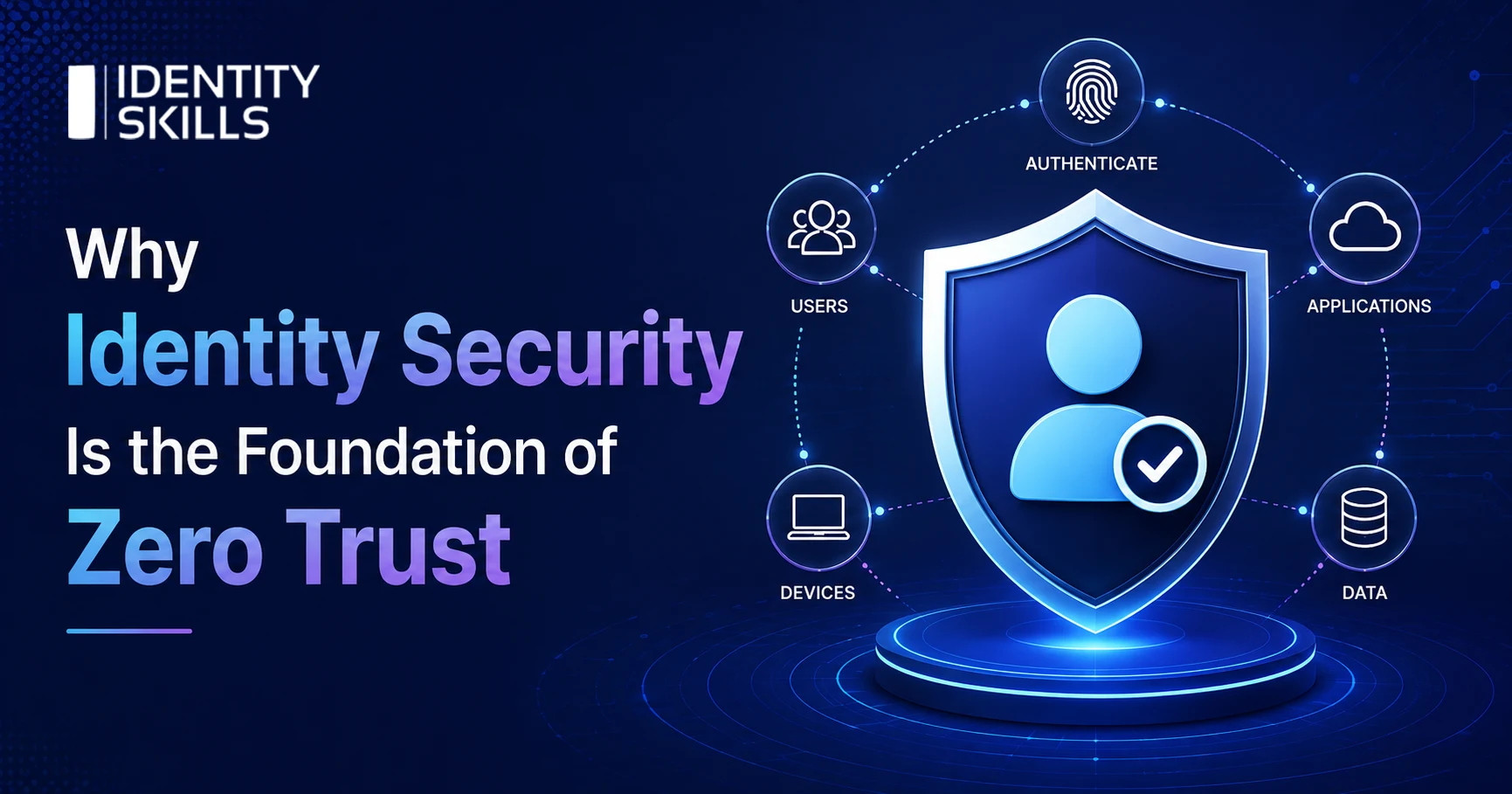
Zero Trust has become one of the most important cybersecurity approaches for modern organizations. As businesses move more applications to the cloud, support remote employees, and use automation and AI, the old idea of trusting users or devices simply because they are inside the company network is no longer enough.
This is where identity security becomes very important.
Zero Trust is built around a simple principle: never trust automatically and always verify access. But to verify access properly, organizations first need to know who or what is requesting access, what they are trying to access, and whether that access should actually be allowed.
That makes identity the center of a Zero Trust security strategy.
What Is Identity Security?
Identity security is the process of protecting digital identities and controlling what those identities are allowed to access.
An identity can belong to a human user, but it can also belong to an application, service account, API, workload, bot, or other machine identity.
A strong identity security strategy helps organizations:
- Verify identities before granting access
- Apply appropriate permissions
- Protect privileged accounts
- Detect unusual identity activity
- Remove unnecessary access
- Secure credentials and secrets
- Monitor identity-related risks
As organizations become more dependent on cloud applications, APIs, automation, and AI, the number of identities they need to protect continues growing.
Why Identity Is at the Center of Zero Trust
Traditional security models often focused on protecting the network perimeter. If a user was inside the corporate network, they were often given a higher level of trust.
That approach doesn’t work very well anymore.
Employees can work from different locations, applications can run across multiple cloud environments, and users can access company resources from many different devices.
Zero Trust changes this approach. Instead of asking, “Are you inside the network?” security teams need to ask questions such as
- Who are you?
- What application or resource are you trying to access?
- What permissions do you need?
- Is this access normal for your role?
- Is the request coming from a trusted device?
- Does the identity show any suspicious behavior?
All of these questions are connected to identity.
Identity Security and the Principle of Least Privilege
Least privilege is another important part of Zero Trust.
The idea is simple: users, applications, and machines should receive only the access they actually need to perform their tasks.
For example, an employee who only needs access to a customer management application shouldn’t automatically receive administrator privileges across the company’s infrastructure.
The same applies to machine identities.
An automation bot may need access to one database, but that doesn’t mean it should have access to every database in the organization.
Identity security helps organizations implement these controls and reduce unnecessary permissions.
How IAM Supports Zero Trust
Identity and Access Management (IAM) plays a major role in Zero Trust by managing who can access specific resources.
IAM technologies can help organizations implement the following:
- Authentication
- Authorization
- Single sign-on
- Multi-factor authentication
- Role-based access control
- Identity lifecycle management
- Access reviews
However, IAM alone isn’t always enough.
Modern organizations also need to protect privileged identities, machine identities, application secrets, and other high-risk credentials.
This is where broader identity security becomes important.
The Role of Privileged Access Management
Privileged accounts have access to sensitive systems and important business resources. If one of these accounts is compromised, the potential impact can be much larger than a normal user account being compromised.
Privileged Access Management (PAM) helps organizations control and protect these high-risk identities.
PAM can help with:
- Securing privileged credentials
- Controlling administrator access
- Applying least privilege
- Monitoring privileged sessions
- Rotating passwords
- Managing privileged accounts
Solutions such as CyberArk are widely used by organizations to strengthen privileged access security.
For cybersecurity professionals, understanding how IAM, PAM, and identity security work together is becoming an important skill.
Human and Non-Human Identities Both matters
One major change in modern cybersecurity is the growing number of non-human identities.
Applications, APIs, cloud workloads, containers, automation bots, and AI agents all need identities to communicate with other systems.
These identities can have significant access privileges, but they don’t behave like normal employees.
For example, an RPA bot may automatically log into several applications every day. An application may use an API credential to communicate with a database. An AI workload may need access to cloud resources.
If these identities are not properly secured, attackers may use their credentials to access sensitive systems.
This is why identity security now needs to cover both human and machine identities.
Identity Security in Cloud Environments
Cloud computing has made identity even more important.
In traditional environments, organizations could build security controls around their physical network. In cloud environments, resources are distributed across multiple platforms and services.
A user may access applications hosted in different cloud environments from a remote location.
Because of this, organizations need identity-based controls that work consistently across their environment.
Identity security helps organizations manage access across:
- SaaS applications
- Public cloud platforms
- Private cloud environments
- Hybrid infrastructure
- APIs
- Databases
- Enterprise applications
This makes identity a key security layer in modern cloud environments.
Identity Security and Continuous Verification
Zero Trust isn’t about verifying a user only once and then trusting them forever.
Access decisions need to consider changing conditions.
For example, a user’s normal login might happen from one location during working hours. A login from an unusual location combined with a sensitive access request could require additional verification.
Identity security solutions can help organizations monitor identity behavior and identify potentially risky activity.
This supports the Zero Trust goal of continuously evaluating access instead of relying on permanent trust.
Why Identity Security Matters for AI and Automation
Artificial intelligence and automation are creating another major identity security challenge.
AI applications, autonomous agents, APIs, and automation platforms need access to data and systems to perform their tasks.
This creates new machine identities and privileged access requirements.
If an AI agent receives excessive permissions, a compromised credential or misconfigured access policy could potentially expose sensitive resources.
As AI adoption grows, organizations will need stronger controls around machine identities and privileged access.
This is another reason identity security is becoming a foundation of modern cybersecurity.
Benefits of Building Zero Trust Around Identity
Organizations that build their Zero Trust strategy around strong identity security can achieve several benefits:
Reduced Attack Surface
Least-privilege access reduces the number of resources an identity can reach.
Better Visibility
Security teams gain greater visibility into who and what is accessing important resources.
Stronger Privileged Access Controls
High-risk accounts can be monitored and protected more effectively.
Improved Cloud Security
Identity-based controls can be applied across distributed cloud environments.
Better Incident Response
Security teams can investigate suspicious identity activity and respond faster.
Support for Compliance
Strong authentication, authorization, access reviews, and audit trails can help organizations meet security and compliance requirements.
Why Cybersecurity Professionals Should Learn Identity Security
The shift toward Zero Trust has increased the demand for professionals who understand identity security.
Cybersecurity teams need people who can work with the following:
- IAM platforms
- PAM solutions
- Multi-factor authentication
- Identity governance
- Privileged accounts
- Machine identities
- Cloud identity
- Secrets management
- Zero Trust architectures
For professionals interested in identity and access management, developing these skills can open career opportunities in security engineering, IAM, PAM, cloud security, and identity administration.
Learning platforms such as CyberArk can also provide practical knowledge of how privileged access and identity security are implemented in enterprise environments.
Conclusion
Zero Trust is more than a security framework. It represents a change in how organizations think about access and trust.
As users, applications, cloud workloads, automation bots, and AI systems connect to business resources from different environments, network location alone cannot determine whether access should be trusted.
Identity provides the context needed to make better access decisions.
That’s why identity security is the foundation of Zero Trust. By protecting identities, enforcing least privilege, securing privileged accounts, monitoring access, and managing both human and machine identities, organizations can build a stronger security strategy for today’s increasingly connected environment.
For cybersecurity professionals, identity security is also becoming an important career skill. As Zero Trust adoption continues to grow, the ability to understand IAM, PAM, machine identities, and identity-based security controls can become a valuable advantage in the cybersecurity job market.