
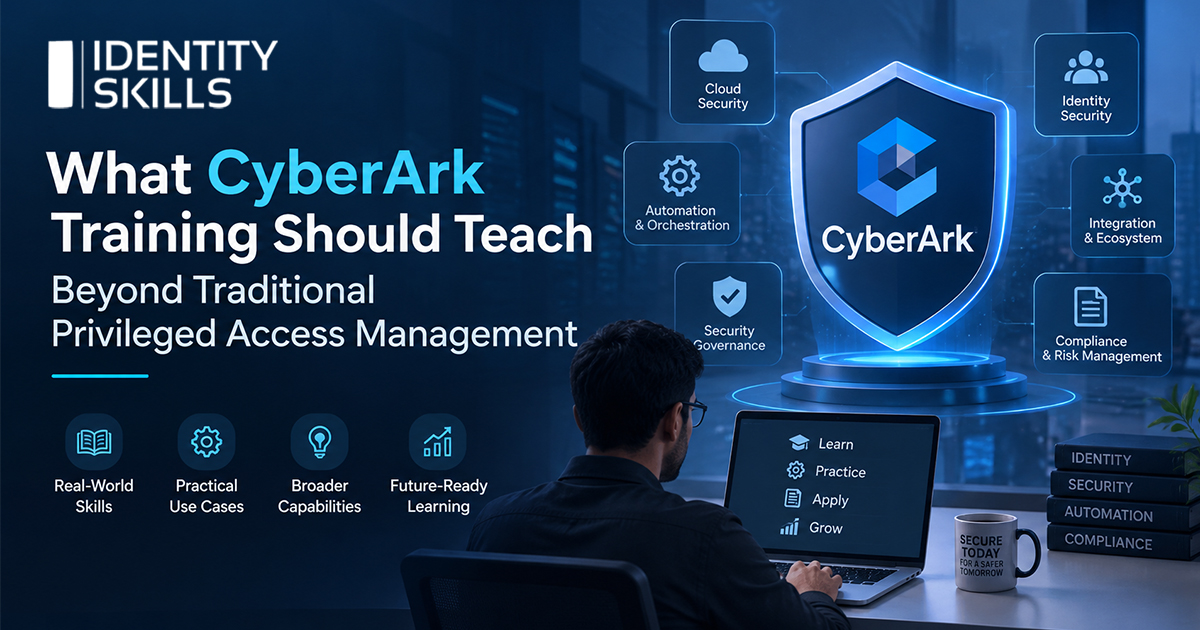
Cybersecurity has changed a lot over the last few years. Privileged Access Management, or PAM, is still one of the most important parts of enterprise security, but the identity landscape is no longer limited to administrator accounts and privileged passwords.
Today, organizations are managing cloud workloads, applications, APIs, automation bots, service accounts, containers, machine identities, and even AI agents. All these systems need some form of identity and access to perform their tasks.
This is why modern CyberArk training should go beyond traditional privileged access management.
Learning how to manage privileged accounts, store passwords in a vault, and rotate credentials is still important. But professionals entering the identity security field also need to understand how privileged access is changing in modern enterprise environments.
The future of CyberArk skills is not only about passwords. It is increasingly about identities, secrets, machines, cloud environments, and automated access.
Traditional PAM Is Still the Foundation
Before looking at modern identity security skills, it is important to understand why traditional PAM remains essential.
Privileged accounts have access to sensitive systems, infrastructure, databases, and business applications. If these accounts are compromised, attackers can potentially gain significant control over an organization’s environment.
Traditional privileged access management focuses on areas such as
- Securing privileged credentials
- Managing administrator accounts
- Password vaulting
- Automatic password rotation
- Session monitoring
- Access approval
- Privileged account auditing
These skills continue to form the foundation of CyberArk training.
However, modern enterprise environments are becoming much more complex.
CyberArk Training Should Include Secrets Management
Passwords are no longer the only credentials organizations need to protect.
Applications and automated systems often rely on secrets such as
- API keys
- Database credentials
- Access tokens
- SSH keys
- Cloud credentials
- Certificates
One common security problem is storing these secrets directly inside application code, scripts, or configuration files.
This can create serious security risks. If source code or configuration files are exposed, attackers may gain access to important credentials.
Modern CyberArk training should help learners understand the basics of secrets management and how organizations can securely manage credentials used by applications and automated workloads.
For a CyberArk professional, understanding how secrets are created, stored, accessed, rotated, and monitored is becoming increasingly valuable.
Understanding Machine and Non-Human Identities
One of the biggest changes happening in identity security is the growth of non-human identities.
A non-human identity can belong to:
- Applications
- Service accounts
- APIs
- Cloud workloads
- Containers
- RPA bots
- Automated systems
- AI agents
These identities often need access to sensitive systems, just like human users.
The challenge is that organizations can have thousands or even millions of machine identities operating across different environments.
Traditional CyberArk training focused mainly on human privileged accounts. Modern training should also help professionals understand how machine identities use credentials and how these credentials can be secured.
This is becoming an important area for the future of identity security.
Cloud Security Should Be Part of CyberArk Training
Most organizations no longer operate only inside traditional on-premises data centers.
Applications and infrastructure are now distributed across public cloud platforms, private clouds, and hybrid environments.
This creates new privileged access challenges.
A cloud administrator, workload, or application may need access to resources across multiple environments. Managing these permissions securely requires a good understanding of cloud identity and access management.
Modern CyberArk training should introduce learners to concepts such as
- Cloud privileged access
- Cloud identity management
- Hybrid environments
- Temporary access
- Least privilege
- Multi-cloud security
CyberArk professionals do not necessarily need to become cloud architects, but understanding how identity security works in cloud environments can be a major advantage.
Why Least Privilege Matters More Today
Giving users permanent administrator access is already considered a major security risk.
The same issue applies to applications, automation bots, and machine identities.
A system should only receive the permissions it actually needs.
This is known as the principle of least privilege.
For example, an automation bot that only needs to read data from one database should not automatically have permission to modify multiple databases.
Modern CyberArk training should teach learners how excessive permissions increase security risks and how privileged access can be controlled more effectively.
This concept is becoming increasingly important as organizations adopt Zero Trust security models.
CyberArk Training and Zero Trust
Zero Trust is based on the idea that access should not be trusted automatically.
Instead, organizations should verify identities and access requests based on context.
CyberArk and Privileged Access Management play an important role in this approach because privileged access represents one of the highest-risk areas in cybersecurity.
Modern CyberArk training should help learners understand how PAM supports Zero Trust through:
- Identity verification
- Least-privilege access
- Privileged session monitoring
- Credential protection
- Access controls
- Continuous monitoring
Understanding these concepts helps learners see how CyberArk fits into a larger enterprise security strategy.
AI Agents Are Creating New Privileged Access Challenges
Artificial intelligence is introducing another major change.
AI agents can perform tasks, call APIs, access applications, retrieve data, and interact with different systems. To perform these tasks, they need identities and permissions.
This creates a new security challenge.
What happens when an AI agent has excessive access? What credentials does it use? How should those credentials be protected? How can security teams monitor what the AI agent is doing?
These questions are becoming increasingly relevant.
CyberArk professionals will need to understand how identity security principles can be applied to AI workloads and autonomous systems.
Modern CyberArk training should therefore introduce learners to concepts related to:
- AI agent identities
- Machine credentials
- Secrets management
- Privileged machine access
- Least privilege for automated systems
- Identity monitoring
The technology will continue changing, but the basic security principle remains the same: identities should receive only the access they actually need.
Automation and RPA Security
Robotic process automation is now widely used in enterprise environments.
RPA bots may log in to applications, process business data, access databases, and perform automated tasks.
This means every bot can become a high-value identity.
If credentials are hardcoded inside automation scripts, attackers may be able to exploit them.
CyberArk professionals should understand how privileged credentials can be protected for automation platforms and RPA bots.
A modern CyberArk training program can introduce practical scenarios involving:
- Bot account security
- Credential vaulting
- Password rotation
- Secrets management
- Least privilege
- Activity monitoring
These skills can help professionals better understand real-world enterprise security requirements.
Monitoring and Visibility Are Becoming Critical
Securing access is important, but organizations also need visibility.
Security teams need to know:
- Who accessed a system
- What identity was used
- When access occurred
- What actions were performed
- Whether the activity was expected
This applies to human users and machine identities.
Modern CyberArk training should help learners understand the importance of privileged activity monitoring and auditing.
Visibility can support incident investigations, security operations, and compliance requirements.
CyberArk Training Should Focus More on Real-World Scenarios
Learning CyberArk concepts is useful, but practical experience is what helps professionals apply those skills in enterprise environments.
Training should include realistic situations such as
- Onboarding privileged accounts
- Managing password rotation
- Responding to failed credential rotations
- Handling service accounts
- Securing application credentials
- Investigating suspicious privileged activity
- Managing access for automation
- Applying least privilege
These scenarios help learners understand why CyberArk is used and how security teams work with PAM in real environments.
What Skills Will Future CyberArk Professionals Need?
CyberArk professionals will still need strong knowledge of PAM fundamentals. But the skill set is expanding.
Future-focused professionals should develop an understanding of:
- Privileged Access Management
- Identity Security
- Secrets Management
- Machine Identity Security
- Non-Human Identities
- Cloud Security
- Automation Security
- Least Privilege
- Zero Trust
- Privileged Session Monitoring
This does not mean a professional must become an expert in every cybersecurity domain.
But having an understanding of how these technologies connect can make a CyberArk professional more effective.
Why Modern CyberArk Training Matters for Career Growth
Organizations are dealing with more identities than ever before.
Employees are using cloud applications. Applications are communicating through APIs. Automation bots are performing business processes. AI agents are beginning to access enterprise tools and data.
All these environments require identity security.
For professionals building a career in cybersecurity, CyberArk training can provide a strong foundation for understanding privileged access and identity security.
However, the most valuable training is not limited to learning a single tool or component.
Modern learners should understand the bigger picture—how privileged access connects with cloud environments, machine identities, secrets, automation, and Zero Trust security.
This broader knowledge can help professionals prepare for changing enterprise security requirements.
Conclusion
Traditional privileged access management remains an important part of cybersecurity, and it will continue to be a core part of CyberArk expertise.
But the identity security landscape is growing beyond administrator passwords and privileged user accounts.
Applications, cloud workloads, APIs, automation bots, service accounts, machine identities, and AI agents all require secure access.
This is why modern CyberArk training should go beyond traditional PAM concepts.
A strong CyberArk learning journey should start with privileged access management fundamentals and then expand into areas such as secrets management, machine identity security, cloud security, automation, least privilege, and Zero Trust.
For cybersecurity professionals, understanding these areas can help build more relevant and future-ready skills.
As organizations continue adopting cloud technologies, automation, and AI, the role of identity security will only become more important. And CyberArk professionals who understand both traditional PAM and the changing identity landscape will be better prepared for the security challenges ahead.