
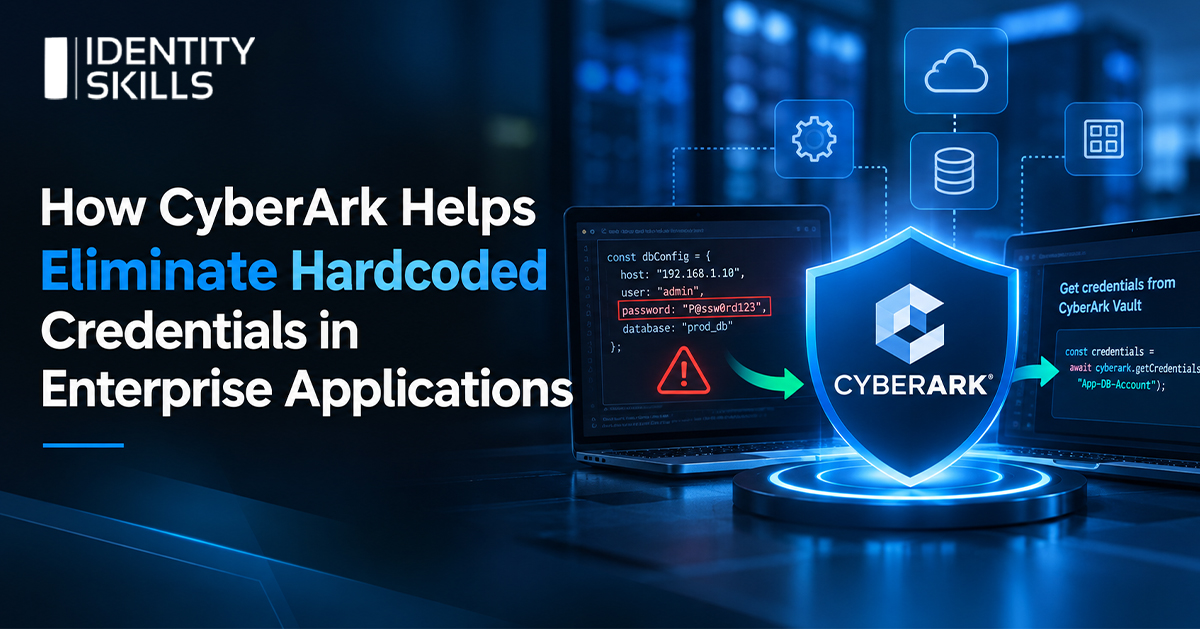
How CyberArk Helps Eliminate Hardcoded Credentials in Enterprise Applications
Hardcoded credentials are still a security problem in enterprise applications.
A developer may store a database password inside application code a script may contain an API key or an automation process may use a service account password saved directly in a configuration file.
At first this may seem like a way to make an application work.
The problem starts when that code or configuration file is exposed.
If someone gets access to the credential they may also get access to the system, database, application or other resources connected to it.
This is where CyberArk can help.
Of keeping sensitive credentials inside application code organizations can store them securely in CyberArk and allow applications to retrieve the required credentials when they need them.
This approach helps reduce the risks associated with hardcoded passwords and unmanaged application credentials.
What Are Hardcoded Credentials?
Hardcoded credentials are usernames, passwords, API keys, database credentials or other secrets that are written directly into application code, scripts, configuration files or automation processes.
For example an application might contain database connection information inside its configuration:
Username: Application account
Password: Stored directly in the configuration
Database: Production database
The application can connect to the database so everything appears to be working
There is a security problem.
Anyone who gains access to the source code or configuration file may also be able to see the credential.
This becomes particularly risky in enterprise environments where applications are connected to important databases, servers, APIs and business systems.
Why Are Hardcoded Credentials a Security Risk?
The biggest problem with hardcoded credentials is that they are difficult to control once they are placed inside application code.
Consider a development team working on an application.
The source code may be stored in a repository shared between developers, copied into environments or included in deployment packages.
If a password is sitting inside that code the credential can potentially travel with it.
There are risks associated with this approach:
Credentials may be exposed through source code
Passwords may be copied between environments
Developers may have access to credentials they do not actually need
Changing the password can require application changes
Old credentials may remain inside previous versions of the code
Security teams may have limited visibility into how credentials are being used
This is why application credentials need to be managed separately from the application itself.
Why Simply Removing the Password Isn’t Enough
A common question is:
“If hardcoded passwords are a problem how will the application authenticate?”
The application still needs credentials to connect to a database, API, server or another system.
The difference is where those credentials are stored and how the application gets them.
Of placing the password directly inside the application the application can request the credential from a secure secrets-management system.
This means the application does not need to know or permanently store the password.
That is where CyberArks application credential management capabilities become useful.
How CyberArk Helps
CyberArk provides a way for organizations to securely store and manage credentials.
Of keeping an application password inside source code the credential can be stored in the CyberArk Vault.
The application can then be configured to retrieve the required credential when it needs access.
The basic idea is:
Application → Requests Credential → CyberArk Vault → Credential Provided → Application Connects
The password itself does not have to be written into the application code.
This helps application logic from credential management.
CyberArks application identity capabilities are designed for scenarios where applications and scripts need access to credentials without relying on hardcoded passwords. Identity Skills also covers application management and Credential Provider/CCP concepts in its CyberArk material.
A Simple Example
Imagine an enterprise application that needs to connect to a production database.
The traditional approach might look something like this:
Application Code → Username + Password → Database
The password is stored somewhere inside the application configuration.
Now consider a secure approach:
Application → CyberArk → Secure Credential → Database
The application requests the required credential from CyberArk rather than keeping the actual password inside its code.
This means the application can still perform its required task while the sensitive credential remains under security management.
What Happens When the Password Needs to Change?
This is another issue with hardcoded credentials.
Passwords should be changed regularly for privileged accounts.
When a password is hardcoded inside an application changing it can become complicated.
Someone may need to:
Change the password
Update the application configuration
Deploy the application again
Check whether the application is still working
Update the credential everywhere else it may have been used
In an enterprise environment this can become difficult to manage.
With CyberArk organizations can use automated password management and rotation capabilities for supported accounts.
The application can continue retrieving the credential without developers having to manually place the new password inside the application.
CyberArk training at Identity Skills covers password rotation, account onboarding, reconciliation, application credentials and related troubleshooting as part of its CyberArk curriculum.
What About APIs and Automation?
Hardcoded credentials are not limited to applications.
Modern businesses use APIs, scripts, DevOps pipelines, RPA bots, cloud workloads and automated processes every day.
These systems also need credentials.
For example an automation script may need:
An API key
Database credentials
A service account
Cloud credentials
An access token
SSH credentials
If these secrets are stored directly inside scripts or configuration files they can create security concerns.
This is becoming more important as enterprises use more automation and machine identities.
Identity Skills recent CyberArk content highlights that application credentials, automation accounts, cloud secrets and other non-human identities are becoming an important part of identity security.
Credential Provider and Central Credential Provider
CyberArk provides approaches for applications that need secure access to credentials.
Two concepts commonly discussed in this area are Credential Provider (CP) and Central Credential Provider (CCP).
Credential Provider
Credential Provider can be used to allow applications to retrieve credentials securely from the CyberArk Vault.
Of storing the actual password inside the application the application can use the appropriate CyberArk integration to obtain the credential when required.
Central Credential Provider
Central Credential Provider provides a managed approach for applications that need to retrieve credentials.
Applications can use a web/API-based method to request the required credential from CyberArk than keeping the password inside application code.
The exact architecture depends on the applications requirements and the organizations CyberArk environment.
The important principle remains the same:
The application needs access to the credential. It does not need to permanently store the credential itself.
How This Helps Development Teams
Moving credentials outside application code is not a security improvement.
It can also make credential management easier for development and operations teams.
Developers can focus on application functionality while security teams manage credentials through the appropriate security platform.
This creates a separation between:
Application Development
and
Credential Management
It also reduces the need for developers to know actual privileged passwords.
That becomes especially useful in organizations where applications are managed by one team, infrastructure by another and security by a separate team.
Centralized Credential Management
Another advantage of using a vault is visibility.
Of having credentials scattered across:
Application configuration files
Scripts
Servers
Deployment packages
Automation tools
Different repositories
organizations can manage sensitive credentials through a centralized security platform.
This makes it easier to understand where credentials are being used and apply security controls.
CyberArks broader PAM capabilities also include password management, access control, session monitoring, auditing and reporting.
Hardcoded Credentials and DevOps
Modern development environments often involve integration and continuous deployment.
Applications may move through environments:
Development → Testing → Staging → Production
Each environment may require different credentials.
If credentials are written directly into configuration files or deployment scripts managing them across all these environments can become difficult.
A secrets-management approach allows sensitive information to be handled separately from the application code.
This is particularly useful when teams are working with cloud environments, APIs, containers, automation and DevOps pipelines.
Modern CyberArk training increasingly includes these areas because identity security is expanding beyond administrator accounts.
What Happens If an Application Credential Is Compromised?
No security solution can eliminate every risk.
However centralized credential management can make it easier to control and respond to compromised credentials.
Organizations can implement processes for:
Password rotation
Access control
monitoring
Auditing
Account management
Least-privilege access
If a credential needs to be changed or access needs to be restricted security teams have a centralized place from which to manage it.
This is much easier than trying to find every application, script and configuration file where a password may have been manually stored.
Why Application Identity Security Matters More Today
Enterprise environmentsre becoming increasingly automated.
Applications communicate with applications.
APIs communicate with APIs.
Bots perform business processes.
Cloud workloads access. Services.
AI systems are beginning to interact with enterprise applications.
All of these systems may require some form of identity and access.
This means identity security is no longer about protecting human users.
Organizations also need to think about machine identities, application identities, service accounts, secrets and automated workloads.
The Picture
Removing hardcoded credentials is not simply about changing one line of code.
It is part of an approach, to identity and privileged access security.
The goal is to make sure that:
Applications get only the access they need
Credentials are stored securely
Passwords can be rotated
Access can be monitored
Sensitive credentials are not unnecessarily exposed
Security teams have visibility
CyberArk can become a part of this approach by offering centralized protection for credentials and controlled access for applications and other non-human identities.
Final Thoughts
Hardcoded credentials may seem like a problem during development but in an enterprise setting they can turn into a major security risk.
Applications need credentials to connect with databases, servers, APIs and other systems. The challenge is ensuring those credentials are not exposed or left unmanaged.
CyberArk offers a way to take credentials out of application code and put them into a secure environment where they can be properly managed.
The main idea is straightforward:
Do not let the application take care of protecting its passwords.
Instead let a specialized identity security platform handle them.
As companies keep moving to the cloud using automation, DevOps, APIs and AI-powered applications, managing application and machine credentials securely will grow more important.
For cybersecurity experts learning about this change is a part of developing real-world CyberArk and identity security skills.
Secure the credential.
Control the access.
Protect the application.
FAQs
What are hardcoded credentials?
Hardcoded credentials are passwords, API keys, usernames, tokens or other sensitive information that are stored directly inside application code, scripts or configuration files.
Why are hardcoded passwords dangerous?
If the source code or configuration file is seen by someone who shouldn’t the credentials inside it may also be seen. Changing these credentials can also be hard if they are used in applications or environments.
How does CyberArk get rid of hardcoded credentials?
CyberArk can keep application credentials safely in its Vault. Let applications get the needed credentials through supported methods for managing application credentials instead of having the actual password in the application code.
What is CyberArk Credential Provider?
Credential Provider is a CyberArk feature that lets applications get credentials from the CyberArk Vault securely without the credentials being stored inside the application code.
What is Central Credential Provider?
Central Credential Provider offers a way for applications to get credentials from CyberArk in a way through a web or API-based connection.
Can CyberArk help with automated applications and bots?
Yes. Application credentials, service accounts, automation accounts and other non-human identities are becoming more important, in identity security.
Why should cybersecurity professionals learn about application credentials?
Modern companies use applications, APIs, automation, cloud workloads and machine identities a lot. Knowing how these identities access resources is therefore a key part of modern identity security and CyberArk work.
Identity Skills. Building Practical Cybersecurity & Identity Security Skills.