
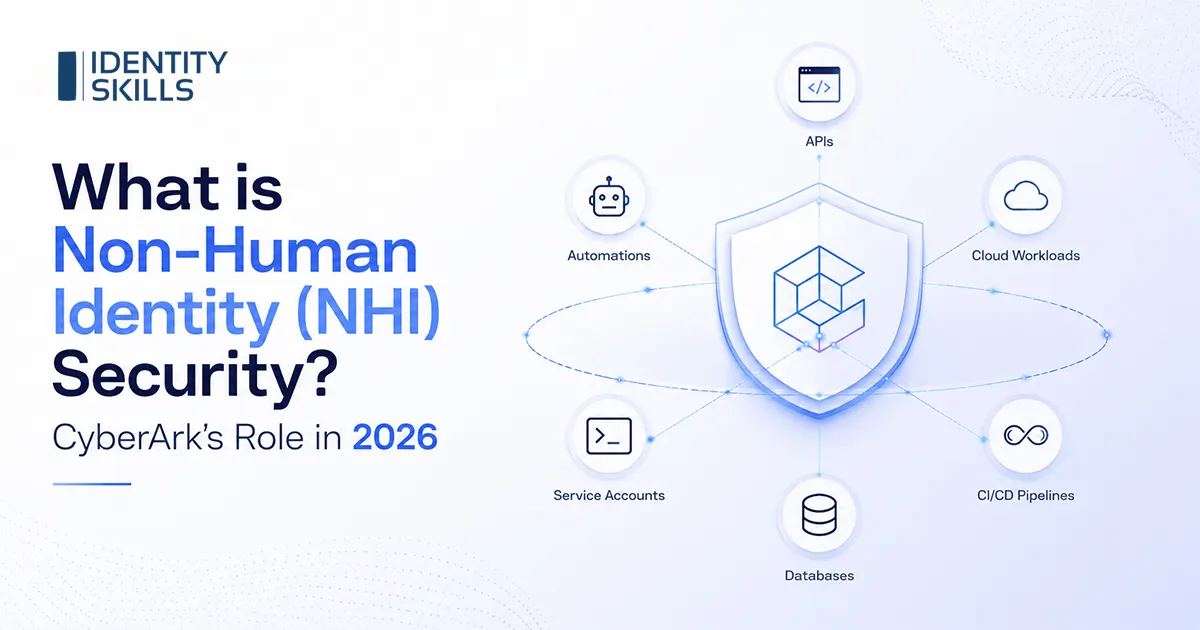
Cybersecurity has traditionally focused on protecting human users, administrator accounts, and privileged credentials. But today’s digital environments look very different than they did a few years ago.
Organizations now rely heavily on cloud platforms, DevOps pipelines, APIs, containers, automation tools, and even AI-driven applications. All of these systems need identities to communicate and access resources securely.
These identities are known as Non-Human Identities (NHIs).
As the number of NHIs continues growing rapidly, securing them has become one of the biggest cybersecurity priorities for organizations in 2026. This is where CyberArk is playing an increasingly important role.
In this blog, we’ll understand what non-human identity security is, why it matters, and how CyberArk helps organizations manage and protect these identities.
What is a Non-Human Identity (NHI)?
A non-human identity is any digital identity that does not belong to a person but still requires authentication and access to systems, applications, or data.
Examples of NHIs include:
- Service accounts
- Application accounts
- API keys
- Access tokens
- SSH keys
- Kubernetes workloads
- Containers
- Cloud workloads
- CI/CD pipelines
- Bots and automation tools
- AI agents
Just like human users need usernames and passwords, these machine identities also require credentials and permissions to perform their tasks.
The difference is that most organizations have far more machine identities than human users.
Why NHI Security is Becoming So Important
Over the last few years, enterprises have rapidly adopted cloud computing, automation, and DevOps practices.
As a result, machine identities have exploded across IT environments.
A modern enterprise may have:
- Thousands of service accounts
- Thousands of API secrets
- Hundreds of cloud workloads
- Multiple automation tools
- AI-powered applications
Each of these identities requires access to systems and sensitive resources.
If these credentials are exposed, attackers can use them to move through environments, access sensitive data, or gain privileged access.
This is why NHI security has become a major focus area in cybersecurity.
Common Risks Associated With Non-Human Identities
Many organizations still struggle to properly manage machine identities.
Some common risks include:
Hardcoded Secrets
Developers sometimes store passwords or API keys directly inside applications or scripts.
If these credentials are exposed, attackers can easily misuse them.
Excessive Permissions
Many machine identities receive more permissions than they actually need.
This creates unnecessary security risks.
Expired Certificates
Certificates that are not properly managed can expire unexpectedly and cause service disruptions.
Lack of Visibility
Organizations often don’t know how many machine identities exist or where credentials are being used.
This creates significant security blind spots.
How CyberArk Helps Secure Non-Human Identities
CyberArk has expanded far beyond traditional privileged access management.
Today, CyberArk provides solutions that help organizations secure both human and non-human identities.
CyberArk helps by:
- Discovering machine identities
- Managing secrets securely
- Rotating credentials automatically
- Protecting API keys and tokens
- Securing service accounts
- Managing certificate lifecycles
- Monitoring privileged access activities
This allows organizations to reduce risk while maintaining operational efficiency.
CyberArk Secrets Management
One of CyberArk’s major strengths is secrets management.
Instead of storing credentials in scripts, code repositories, or configuration files, CyberArk allows organizations to securely store and manage secrets centrally.
This includes:
- Database credentials
- Cloud credentials
- API keys
- Access tokens
- Application passwords
Automated secret rotation further reduces the risk of credential exposure.
CyberArk Certificate Management
Certificates are a critical part of machine identity security.
CyberArk Certificate Manager helps organizations:
- Discover certificates
- Track certificate usage
- Automate renewals
- Monitor expirations
- Reduce outages caused by expired certificates
This becomes increasingly important as cloud environments continue growing.
CyberArk and AI-Driven Environments
One of the biggest cybersecurity trends in 2026 is the rise of AI agents and autonomous systems.
These AI-powered systems often require:
- API access
- Database access
- Cloud permissions
- Application credentials
In many ways, AI agents are becoming highly privileged non-human identities.
CyberArk helps organizations secure these identities using the same security principles applied to privileged human users:
- Least privilege
- Credential protection
- Secret rotation
- Identity governance
- Access monitoring
This makes CyberArk highly relevant in modern AI-driven environments.
Why Organizations Are Investing in NHI Security
Organizations are realizing that attackers don’t only target human accounts anymore.
Machine identities often have powerful permissions and can become attractive targets.
By implementing NHI security strategies, organizations can:
- Reduce credential-related risks
- Improve compliance
- Strengthen cloud security
- Secure DevOps environments
- Protect AI workloads
- Improve visibility across identities
As machine identities continue growing, these benefits become even more important.
Career Opportunities in NHI Security
As NHI security becomes a major focus area, cybersecurity professionals with knowledge of:
- CyberArk
- Secrets management
- Certificate management
- Identity security
- Cloud security
- DevOps security
are likely to see increasing demand in the job market.
Many organizations are already looking for professionals who understand both traditional PAM and modern machine identity security concepts.
Final Thoughts
Non-human identity security is becoming one of the most important areas in cybersecurity as organizations continue adopting cloud, automation, DevOps, and AI technologies.
Machine identities now outnumber human users in many enterprise environments, making them a critical security priority.
CyberArk is helping organizations address this challenge by securing secrets, managing certificates, protecting service accounts, and improving visibility across machine identities.
As we move through 2026 and beyond, understanding non-human identity security will become increasingly valuable for both organizations and cybersecurity professionals looking to stay ahead of evolving security challenges.